DORA Compliance in 2026: Why Third-Party Risk Management Is a Business Priority
Introduction
Financial services depend on an increasingly interconnected technology ecosystem. Banks, payment institutions, fintech companies, and insurance providers rely on cloud platforms, SaaS applications, managed security services, and outsourced infrastructure to deliver critical services.
But what happens when a technology provider faces a cyberattack, a prolonged outage, or a supply chain failure?
The consequences can extend far beyond the provider itself.
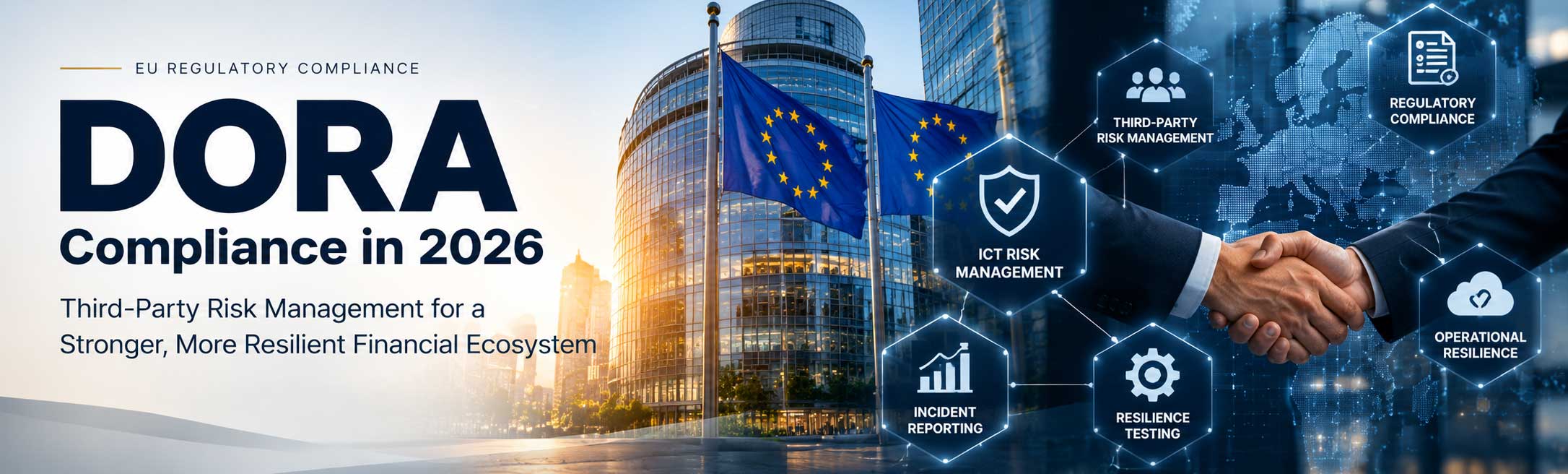
The European Union’s Digital Operational Resilience Act (DORA) addresses this challenge by establishing requirements for ICT risk management and digital operational resilience across in-scope financial entities. Since DORA became applicable on 17 January 2025, organizations have needed to move beyond policy documentation and demonstrate how their resilience controls work in practice.
In 2026, third-party risk management remains a key focus. Financial institutions need visibility into their technology dependencies, while ICT service providers need to understand their financial-sector customers’ security and contractual expectations.
This guide explains the key DORA third-party risk management requirements, common implementation challenges, and practical steps organizations can take to strengthen compliance readiness.
What Is DORA Third-Party Risk Management?
DORA third-party risk management concerns the risks financial entities face when relying on external ICT service providers.
These providers may include:
- Cloud infrastructure and hosting companies
- Software-as-a-Service (SaaS) providers
- Managed service providers
- Cybersecurity and security operations providers
- Data processing and storage services
- IT outsourcing and application support partners
An organization cannot assume that outsourcing a technology function transfers its regulatory responsibilities to the service provider.
Financial entities remain responsible for complying with their applicable DORA obligations, including managing risks associated with ICT third-party arrangements.
The objective is to establish appropriate oversight throughout the lifecycle of a supplier relationship, from initial due diligence and contracting to ongoing monitoring and eventual exit.
Why Is DORA Compliance Important in 2026?
DORA is not simply a cybersecurity checklist. It establishes a broader framework for digital operational resilience. Organizations need to consider whether their ICT risk management practices can identify, withstand, respond to, and recover from disruptions.
Third-party risk matters because a single provider may support multiple business functions or serve as a dependency for several critical services.
The European Banking Authority published final guidelines on managing third-party risk on 18 September 2026. The guidelines focus on arrangements supporting critical or important functions and address due diligence, contracting, subcontracting, monitoring, documentation, and exit strategies. Organizations should evaluate these guidelines alongside DORA and other relevant requirements, rather than treating every third-party arrangement the same.
Key DORA Third-Party Risk Management Requirements
1. ICT third-party risk assessment
Financial entities should understand the risks associated with their ICT service providers before entering into arrangements and throughout the relationship.
A structured assessment may consider:
- The provider’s security controls and certifications
- Data confidentiality, integrity, and availability
- Service availability and recovery capabilities
- Geographic locations where services and data are processed
- Subcontracting arrangements
- Incident notification and escalation procedures
- Concentration and dependency risks
The assessment should be proportionate to the nature, scale, complexity, and importance of the service.
2. Contractual requirements
DORA establishes requirements for contractual arrangements involving ICT services, with additional requirements for services supporting critical or important functions.
Organizations should review whether agreements address applicable provisions on service descriptions, service delivery and data processing locations, security measures, incident assistance, cooperation with relevant authorities, audit and access rights, and termination or transition arrangements.
Contracts should also be reviewed for appropriate provisions relating to subcontracting, where applicable.
A contract review is most effective when supported by a documented risk assessment and an understanding of how the service operates in practice.
3. Register of information
DORA requires financial entities to maintain a register of information concerning their contractual arrangements for the use of ICT services provided by ICT third-party service providers.
This register helps organizations maintain visibility into their external technology dependencies and supports relevant supervisory processes.
An effective process should establish:
- Clear ownership of supplier information
- Consistent identification of ICT services and providers
- Mapping of relevant services to business functions
- Visibility into subcontracting and dependencies where required
- Regular validation of the accuracy and completeness of records
- A repeatable process for updating the register when arrangements change
Incomplete supplier inventories or inconsistent records can make risk oversight and regulatory reporting more difficult.
4. Ongoing monitoring and performance oversight
Third-party risk management should continue after a contract is signed.
Organizations should define appropriate methods to monitor provider performance, security posture, incidents, material service changes, and compliance with contractual obligations.
Evidence may include independent assurance reports, security assessment results, incident records, service-level reports, business continuity test results, and remediation updates.
The appropriate evidence depends on the service’s risk and nature. A certificate or SOC report can provide useful assurance, but it does not automatically establish DORA compliance.
5. Exit strategies and resilience planning
Organizations should understand how they would respond if a provider became unavailable, experienced a serious incident, or could no longer meet contractual requirements.
An exit strategy should be practical, not just documented.
Depending on the service, planning may include data portability, alternative providers, migration procedures, recovery capabilities, contractual termination rights, and measures to maintain continuity during transition.
For critical dependencies, organizations should evaluate whether their arrangements and operational plans support their applicable resilience objectives.
A Practical DORA Third-Party Risk Assessment Process
A structured assessment can help organizations identify gaps and prioritize remediation.
Step 1: Define the scope. Identify relevant business functions, ICT services, suppliers, contractual arrangements, and applicable requirements.
Step 2: Classify supplier risk. Evaluate the importance of the service, its dependencies, the potential impact of disruption, and relevant concentration risks.
Step 3: Review documentation. Examine contracts, due diligence records, risk assessments, security evidence, incident procedures, and relevant registers.
Step 4: Validate controls. Assess how supplier oversight, monitoring, incident escalation, business continuity, and exit arrangements operate in practice.
Step 5: Identify gaps. Document deficiencies, assess their potential impact, and assign remediation priorities.
Step 6: Establish ongoing oversight. Define owners, review intervals, evidence requirements, escalation criteria, and reporting mechanisms.
Common DORA Compliance Challenges
Organizations frequently encounter challenges such as:
- Incomplete inventories of ICT suppliers and services
- Contracts that do not adequately address applicable requirements
- Limited visibility into subcontracting arrangements
- Inconsistent supplier risk classifications
- Difficulty maintaining accurate registers of information
- Reliance on outdated or insufficient assurance evidence
- Exit strategies that have not been tested
- Unclear accountability across procurement, IT, security, legal, and compliance teams
These issues are easier to address when organizations integrate third-party risk management into their broader governance, risk, and compliance program.
How E Com Security Solutions Can Help
E Com Security Solutions supports organizations through DORA compliance assessments, ICT risk reviews, third-party risk assessments, evidence mapping, gap identification, and remediation planning.
Our approach helps clients understand applicable requirements, evaluate existing controls, identify improvement opportunities, and establish a practical compliance roadmap.
Depending on the engagement scope, support may include:
- DORA applicability and scope assessment
- ICT third-party risk management reviews
- Supplier security and contractual control assessments
- Register of information process reviews
- Control gap analysis and remediation recommendations
- Evidence readiness and follow-up validation
For ICT service providers supporting financial institutions, an assessment can also identify gaps between existing security practices and expectations set out in customer contracts and assurance requirements.
Conclusion
DORA third-party risk management is an ongoing governance responsibility, not a one-time vendor questionnaire.
Financial entities need a clear understanding of their ICT dependencies, appropriate contractual protections, reliable supplier information, effective monitoring, and workable exit strategies.
Technology providers can also benefit from understanding how their security controls and evidence support their financial-sector customers’ resilience requirements.
A structured DORA compliance assessment helps organizations identify gaps, prioritize risks, and strengthen their digital operational resilience.
Ready to assess your DORA compliance posture?
E Com Security Solutions can help you evaluate ICT risk management, third-party dependencies, and compliance gaps. Get Started >>
Contact our team to discuss your DORA assessment requirements.
Disclaimer: This article provides general information and is not legal advice. Applicability depends on the relevant legal entity, services, jurisdiction, exemptions, and applicable regulatory requirements.